
|
|
The U.S. and Israeli war against Iran have brought the countries’ militaries – that have always been close – to levels never seen before, prompting one former senior U.S. defense official to say there has been a “mind meld” between militaries, according to a report.
President Donald Trump has presented himself as the greatest friend Israel has ever had, and he has surrounded himself with a pro-Zionist administration.
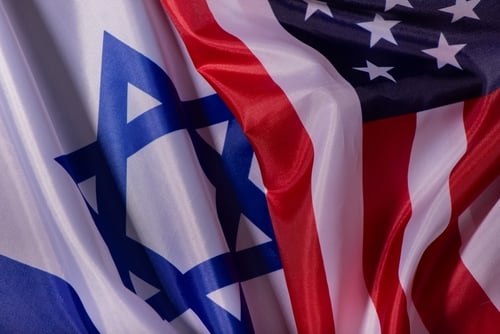
Pete Hegseth, the U.S. secretary of War, spoke to reporters at the Pentagon about the closeness between countries during the war in Iran and said when Iranians look up and see fighter jets with the “Stars and Stripes and the Star of David,” they know that it’s the “evil regime’s worst nightmare.”
The Financial Times reported that it has long been understood that the U.S. plays a major role in funding and supporting the Israeli military with “tens of billions of dollars in weapons and arms.” Throughout the ongoing genocide in Gaza, Washington helped provide Tel Aviv with diplomatic support to ensure that the massacres continue. (See “UN SECURITY COUNCIL APPROVES TRUMP’S PLAN FOR INTERNATIONAL STABILIZATION FORCE IN GAZA, HAMAS REJECTS” (18 Nov 2025).
But the paper, citing former U.S. and Israeli officials, said the alliance in the war with Iran is “without parallel” and required “thousands of phone conversations every day between the two militaries.”
The report said one would have to look back to WWII to find the last time countries were so coordinated during a war.
Dana Stroul, a former senior U.S. defense official from the Washington Institute, told the paper that the U.S. normally develops a “broad coalition” during recent wars and lays out the “concept of operations.”
These partners are usually given specific roles, but in Iran, Israel and the U.S. are partners on “equal footing.”
The FT said the cohesion could not have happened without Trump’s first term in office, which included the Abraham Accords in 2020. A year later, the Israeli military began working with U.S. Central Command (CENTCOM) after having worked with the European Combat Command, the report said.
One former IDF general told the paper that the cooperation in the war with Iran could not have happened without Israel joining CENTCOM.
TRENDPOST: It is worth noting that the FT’s report on the IDF and U.S. war planning before the 28 February sneak attack further shows that the negotiations between Washington and Iran about the nuclear program were just subterfuge to help prepare for this war. (See “NETANYAHU WANTS U.S. TO BE UNBENDING IN DEMANDS DURING NEGOTIATIONS WITH IRAN” (10 Feb 2026), and “TRUMP SAYS ADMINISTRATION AND IRAN IN SERIOUS TALKS TO COME UP WITH NUKE DEAL” (3 Feb 2026).
Eyal Zamir, Israel’s top military officer, told the FT that Israeli security officials visited Washington in the weeks before the initial strike to talk about how the war could unfold. One Israeli told the paper, “We understood from the political level that we were heading into another confrontation, and we went to the Pentagon to plan.”
Partners in Crime
Hegseth described Israel as a partner that is willing to fight, unlike some allies who “wring their hands and clutch their pearls.”
The FT report said the Israeli military focused on central and western Iran, while the U.S. targeted the southern part of the country. The paper said it spoke to Israeli officials noting how the U.S. maintains many refueling jets in the region that have been instrumental in long-range bombings.
The New York Times reported that there has long been concern in the U.S. that a decision to fight in a war with Israel could damage the U.S.’s reputation in the Middle East with Arab countries.
Dennis Ross, who was a Middle East envoy for Bill Clinton, told the paper that the level of cooperation between Israeli and U.S. forces in Iran is something that would have been “unthinkable in the past.”
Eliot Cohen, a senior State Department official during the George W. Bush administration, told the paper that Gulf states will change their calculations after seeing the close U.S.-Israel alliance.
“You have to think, ‘Gosh, the next time, the Americans and Israelis might come after us together,’” he said.
TRENDPOST: The Times noted that there are inherent risks working so closely with another military that could have different long-term goals. The U.S. has appeared flexible on its aims in Iran, while Tel Aviv’s position has been regime-change-or-bust.
Marwan Muasher, a former Jordanian foreign minister who is currently the vice president for studies at the Carnegie Endowment for International Peace, told the paper that the U.S. has never presented itself as an honest broker in the region, but just not in such a “blatant manner” as the region is witnessing in Iran.
“It’s not hiding the fact that it is cooperating with Israel, nor apparently does it care for the reaction in the Arab world,” he said.